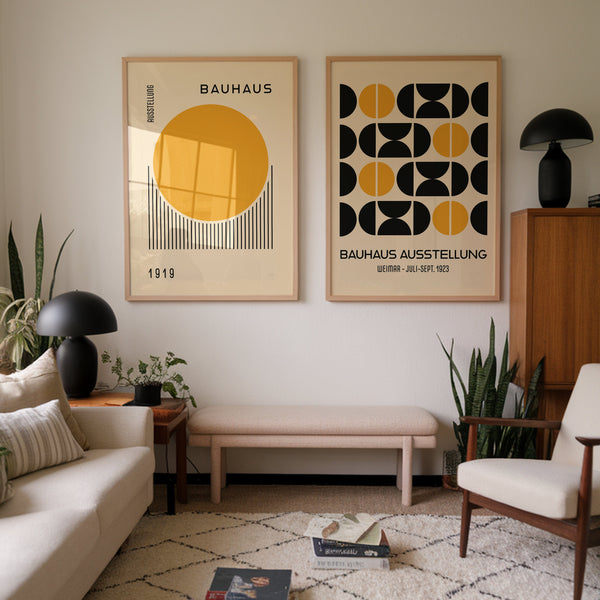
Bauhaus Posters: Art Prints Collection
Discover our curated collection of Bauhaus art prints, where bold geometry, clean lines, and timeless design converge. Featuring both modern and framed Bauhaus posters, this collection honors the pioneering 1920s movement that transformed the worlds of art, design, and architecture.
- Large orange circle and stripes
- Black stripes on beige
- Warm retro character
- Overlapping blue and brown circles
- Flat blue, pink and brown
- For a modern bedroom
- Eye motif within geometric forms
- Bauhaus geometry in primary colours
- For a creative workspace
- Orange semicircle with dotted grid
- Black, orange and beige
- Works above a sideboard
- White circles amid flowing lines
- Black ground with white linework
- Designed for a study
- White dot grid with cut-outs
- Bauhaus type beneath pattern
- Desk-side display
- White circles and waisted shapes
- Bauhaus typography and geometry
- Clean visual rhythm
- Two stylised black eyes
- Black and white Bauhaus type
- Under a picture light
- Rounded shapes across colour panels
- Orange, yellow, blue and pink
- Suited to a children's room
- An eye among rounded shapes
- Bauhaus shapes in blue, orange, red
- Suits a lively workspace
- Semicircles and sweeping curves
- Pink, red and orange hues
- By a clean-lined desk
- Stacked semicircles and blocks
- Rust, scarlet and ochre
- Lively exhibition character
- Bauhaus lettering with geometric forms
- Orange, teal, mustard and charcoal
- Measured graphic rhythm
- Semicircles beneath Bauhaus lettering
- Green, purple and white
- Beside a reading chair
- Bauhaus lettering and curved shapes
- Rust, ochre and charcoal
- Suited to a creative studio
- Stacked circles and Bauhaus lettering
- Red, orange and yellow palette
- Living room colour note
- Blue eye beneath orange lines
- Orange, blue and white Bauhaus
- In a hallway setting
- Repeating concentric circles
- Black and white linework
- Hangs neatly in hallways
- Two white eyes and lettering
- Bauhaus lettering in monochrome
- Display in a creative workspace
- Red circles on wavy stripes
- Black, red and beige
- Made for a modern lounge
- Dense black dot matrix
- Bauhaus dot-matrix styling
- Made for a hallway
- Black circles and pinched forms
- Bauhaus black-and-white layout
- In a minimalist workspace
- Black dots beside looping stripes
- Clean monochrome stripework
- Quietly measured presence
- Eye between two coloured circles
- Beige, orange and blue
- Beside a pale console
- Overlapping teal and orange circles
- Beige, teal and orange palette
- Ideal for a workspace
- Blue and yellow circles, striped arches
- Bauhaus black, blue and yellow
- Beside natural wood furniture
- Bauhaus text above fading stripes
- Teal, sage and beige
- Complements oak furniture
- Overlapping semicircles with Bauhaus lettering
- Black, red and peach
- Against a soft white wall
- Red curved shapes in rows
- Bauhaus red and pink pattern
- Retro 1920s character
- Black dots and organic shapes
- Bauhaus Exhibition 1923 lettering
- Refined modernist presence
- Pink and orange diagonal blocks
- Warm pink, orange and cream
- At home in living rooms
- Three overlapping coloured circles
- Teal, cream and orange palette
- Retro feel for hallways
- Black curves with orange circles
- Mid-century linework
- Above a compact console
- Six red shapes and lettering
- Red, white and black palette
- By a hallway console
- Three pairs of stylised eyes
- Orange ground, blue and red
- Brightens a creative workspace
- Blue circle and black stripes
- Blue, black and white Bauhaus
- Complements light oak
Collection guide
A closer look at Bauhaus Posters: Art Prints Collection
Explore the story, styling ideas and practical answers behind this collection.
Collection guide
The Bauhaus lasted fourteen years and changed what design looks like for the century after it. These Bauhaus art prints work in that language - primary colour, circle, square and triangle, type as a structural element rather than a label.
Where the style comes from
Walter Gropius founded the school in Weimar in 1919 on a simple principle: art and craft should not be separate disciplines, and a chair, a building and a poster should all be designed with the same rigour. The school moved to Dessau in 1925, into the glass-and-steel building that became its emblem, then to Berlin, and closed under Nazi pressure in 1933. Its teachers scattered across Europe and America and took the method with them.
The visual signature came largely from the teaching: Kandinsky's colour theory, Itten's contrast exercises, Albers on how one colour changes another. The result is work built from a small vocabulary - three primaries plus black and white, three shapes, hard geometry - which is exactly why it still looks current.
What makes a print read as Bauhaus
Flat colour with no shading. Shapes that meet cleanly rather than overlapping softly. Asymmetry that is clearly deliberate, usually built on a grid you can sense but not see. And restraint - Bauhaus artwork rarely uses more than four colours, which is what stops it feeling busy even when the composition is bold.
That discipline makes these prints unusually easy to hang. They sit well in a plain modern room, they pair with mid-century furniture, and a set of two or three in the same palette reads as one composition.
Where they work
Offices, studios and hallways take Bauhaus prints particularly well, because the geometry reads as considered rather than decorative. In a living room, one large piece above a sofa or sideboard does more than a grouping. Primary red and yellow lift a room with cool light; the black, white and grey end of the collection suits a room that already has strong colour in the furniture.
Start with these
- Golden Dawn - warm ochre geometry, the easiest way in.
- Bauhaus Blueprint - structural lines in blue and black.
- Bauhaus Cubes - stacked forms for a pair or a set of three.
- Bauhaus Calm II - the quietest of the collection.
Sizes and framing
Geometry rewards scale, so larger formats usually read better. Mark the outside dimensions on your wall with paper or removable tape before ordering and check it from where you usually sit. Match any frame to the exact print size, as similar-looking metric and inch formats are not interchangeable. Plain black or natural wood suits this work; ornate frames fight it. We offer framing too, so get in touch for options and prices.
See the wall art size guide to compare formats, plus delivery information and returns and replacements.
Read more
On the school and the people who ran it: who started the Bauhaus.
Related collections
- Abstract Art Prints - the wider collection this sits inside.
- Mid-Century Modern Wall Art - what the Bauhaus emigrés influenced next.
- Black and White Art Prints - the same discipline without the primaries.
- Office Wall Art - geometric prints for a working room.
Questions about Bauhaus Posters: Art Prints Collection
Good to know
Questions about Bauhaus Posters: Art Prints Collection
What are the size categories for art prints?
Art Print Size Categories
To answer the question "What are the size categories for art prints?" we can break it down into several distinct categories based on the longest edge of the print:
- Mini: Perfect for compact spaces, these prints have their longest edge measuring less than 40 cm.
- Small: Ideal for cozy nooks or gallery walls, these prints range from 40 cm to 60 cm on their longest edge.
- Medium: A versatile choice for various decors, these prints have their longest edge between 60 cm and 80 cm.
- Large: Making a bold statement, these prints feature a length ranging from 80 cm to 100 cm on their longest side.
- Extra Large: For grand displays that demand attention, these prints stretch from 100 cm up to 120 cm at their longest.
These categories help in choosing the right print size to match the aesthetic and spatial needs of different environments.
What color options are available for art prints?
When selecting an art print, you have a vibrant array of color options to choose from
Allowing you to match your personal style and home decor seamlessly.
Here's a breakdown of the available colors:
- Bright and Bold: Infuse energy into your space with shades like orange, red, or yellow that can instantly draw attention.
- Cool and Calming: Opt for blues or greens to create a soothing atmosphere that evokes peace and tranquility.
- Neutrals and Classics: Consider the versatility of grey or black for an understated elegance that complements a variety of interiors. Playful and
- Creative: Inject fun into any room with cheerful colors like pink or purple that make a statement.
- Timeless Options: Black and white prints offer a classic look with refined contrast, suitable for any decor style.
These color options ensure that your chosen art prints can enhance the aesthetic appeal of your environment while reflecting your personal taste.
Who are some notable artists associated with the Bauhaus?
Renowned Bauhaus Artists
When discussing the influential artists tied to the Bauhaus movement, several key figures immediately come to mind.
- Paul Klee: Known for his unique style that combined expressionism, cubism, and surrealism, Klee's work was integral to the philosophy of the Bauhaus, where he also taught.
- Wassily Kandinsky: Often considered a pioneer of abstract art, Kandinsky brought his revolutionary ideas about color and form to his teaching at the Bauhaus.
- László Moholy-Nagy: This artist was not only a painter but also renowned for his contributions to photography and industrial design, reflecting the Bauhaus's fusion of art and technology.
- Theo van Doesburg: While not an official Bauhaus member, his De Stijl movement heavily influenced the school’s aesthetics and his interactions with Bauhaus students and faculty were significant.
- Joost Schmidt: As a master at the Bauhaus, Schmidt is perhaps best known for his innovative graphic design work, which showcased the movement's bold, clean lines.
- Oskar Schlemmer: Schlemmer's multidisciplinary talents spanned painting, sculpture, and stage design, and his work in the Bauhaus’s theater workshop was particularly groundbreaking.
These artists, among others, were central to shaping the Bauhaus's legacy, revolutionizing modern art and design with their forward-thinking approach.
Which artists are featured in the Bauhaus category?
The Bauhaus movement is celebrated for its influential artists who have left an indelible mark on the art world
In this category, you'll find several renowned figures: Paul Klee: Known for his vivid color palettes and abstract forms, Klee's work exemplifies the spirit of creativity and innovation that Bauhaus embraced. Wassily Kandinsky: As a pioneer of abstract art, Kandinsky's contributions were fundamental, adding a rich layer of expressive depth to the movement. László Moholy-Nagy: A visionary in design and photography, Moholy-Nagy seamlessly integrated technology with art, pushing the boundaries of visual culture. Theo van Doesburg: Known for his role in both De Stijl and Bauhaus, van Doesburg promoted geometric abstraction, influencing generations of artists. Joost Schmidt: Renowned for his graphic design and typography, Schmidt's work remains a cornerstone of modern visual communication. Oskar Schlemmer: Famed for his multidisciplinary approach, Schlemmer's contributions to performance and stage design were cutting-edge for his time.
Each of these artists played a pivotal role in shaping the Bauhaus movement, crafting a legacy that continues to inspire contemporary creativity.
What was the Bauhaus and who founded it?
The Bauhaus was a pioneering art and design school established in Germany in 1919. Its founder, Walter Gropius, envisioned a revolutionary institution that blended the realms of fine art and practical design. This integration aimed to craft items that were not only aesthetically pleasing but also functional. Students at the Bauhaus engaged in a diverse curriculum, exploring a wide range of disciplines such as furniture making, textiles, and visual arts. The school's core philosophy, often summarized as "Art into Industry," encouraged a seamless fusion of artistry and craftsmanship. This avant-garde approach significantly impacted modern design, art, and architecture, leaving a lasting legacy on these fields.
Which disciplines were taught at the Bauhaus School?
The Bauhaus school offered a diverse range of disciplines
Including cabinet making, weaving, and painting. Instruction was guided by the principle of integrating art with industry, ensuring that each craft was taught with a focus on practical application and innovation. Students were encouraged to blend creativity with functionality across these fields, preparing them for the evolving demands of the modern industrial landscape.
What philosophy did the Bauhaus follow in its educational approach?
The Bauhaus embodied an educational philosophy centered on integrating art with industry
Students received training across various disciplines, including cabinet making, weaving, and painting. This approach encouraged the blending of creative expression with practical skills, ensuring that art wasn't merely theoretical but could be applied in industrial contexts to enhance functionality and design.
How can one personalize their art print with bespoke framing?
Personalizing Your Art Print with Bespoke Framing
Bespoke framing offers a unique opportunity to tailor your art print to your personal style and the decor of your space.
Here’s a detailed guide on how to do just that:
Choose Your Frame Style Material Options: Select from a variety of materials such as wood, metal, or acrylic to match the aesthetic you're going for.
Color and Finish: Opt for a classic black or white frame, or go bold with a metallic finish. Natural wood tones can add warmth to your artwork.
Size Matters Custom Sizing: Ensure the frame fits your print perfectly. Measure your artwork carefully and consider if you want any matting or borders. Proportional Balance: The size of the frame should complement, not overpower, the artwork. A slim frame might suit a minimalist print, whereas something more ornate could elevate a traditional piece.
Protective Features UV-Protection: Choose a frame with UV-protective glass to guard your art against fading.
Glare Reduction: Look for anti-glare options to enhance the viewing experience.
Framing Techniques Floating Frames: Creates a 3D effect by suspending the art within the frame, adding a modern touch.
Matted Frames: Adds a border around the print which can enhance depth and focus on the artwork.
Local Artisans By working with local framers or artisans, you can add a personal touch and ensure premium craftsmanship. Many professionals also offer guidance in selecting the perfect frame style.
Final Tips Harmony with Home Decor: Keep your existing interior design in mind to achieve a cohesive look.
Try Before You Buy: Some frame shops offer virtual previews of your framed art, allowing you to visualize the final product.
By taking the time to choose a bespoke frame, you’ll not only protect your art print but also create a stunning display that reflects your personal taste.
How can one stay updated about new collections and artist interviews?
Join the artist community! Be first to discover new wall art and upcoming trends and plenty more
Stay ahead of the curve by subscribing to our newsletter. You'll be the first to hear about: New collections: Get the latest on breathtaking pieces that will transform any space. Limited edition launches: Secure exclusive art that few others will have. Artist interviews: Dive into the minds of creators shaping the art world today.
Don't miss out on these insights and updates designed to keep you informed and inspired.
CONTINUE BROWSING
Recently Viewed
Art worth coming home to
New releases, styling ideas and private offers.
Resources
Laboo Studio
Customer Support
☎: +44 203 769 6880
✉: hello@laboostudio.com
⚲: 128 City Road, EC1V 2NX, UK
was added to your cart
Save your favourite prints by selecting the heart on any product.