Angel paintings turn up on Christmas cards every December, and many of the best loved come from Renaissance Italy, when artists in Florence, Rome and beyond painted heavenly messengers with real faces, bright wings and flowing robes. This guide looks at the most famous examples, from the Annunciation scenes of Fra Angelico and Leonardo to Raphael's two small cherubs and the dancing angels of Botticelli, and explains what each one shows.
What are the most famous angel paintings?
A short list would include the Annunciation frescoes of Fra Angelico, Leonardo da Vinci's Annunciation, the angel Leonardo painted in Verrocchio's Baptism of Christ, the cherubs at the foot of Raphael's Sistine Madonna, and Botticelli's Mystic Nativity, along with the many Madonnas Botticelli surrounded with angels. Most of them were painted for churches, monasteries and private chapels, and almost all of them tell part of the Christmas story.
Who painted the most famous Annunciation?
The Annunciation is the moment the angel Gabriel tells Mary that she will bear the son of God, and it was one of the most painted subjects of the Renaissance. Three versions stand out.
Fra Angelico. A Dominican friar, Fra Angelico painted a series of frescoes for the friary of San Marco in Florence in the late 1430s and 1440s, many of them in the small cells where the friars slept and prayed. His best known Annunciation faces visitors at the top of the stairs to the dormitory. Gabriel bows before Mary in a quiet arched porch, his wings striped in rows of bright colour, and the whole scene is calm and almost silent. The name Fra Angelico is a nickname meaning the angelic friar, and San Marco is now a museum where you can still see his work on the walls where he painted it.
Leonardo da Vinci. Leonardo's Annunciation, in the Uffizi in Florence, dates from about 1472 to 1476, when he was still a young artist trained in the workshop of Andrea del Verrocchio. Gabriel kneels on a flowering lawn holding a white lily, the symbol of Mary's purity, while she looks up from a book on a carved stand. Behind them a misty landscape of trees and mountains fades into the distance.
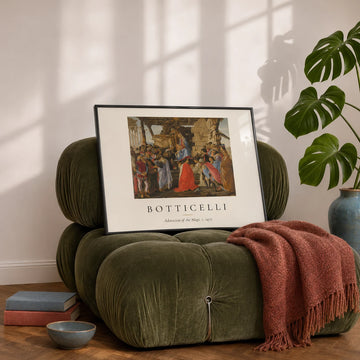
Botticelli. Botticelli's own version, often called the Cestello Annunciation after the church it was painted for, dates from about 1490 and also hangs in the Uffizi. Here Gabriel has just landed and kneels, and Mary sways away from him with her hands raised, a far more dramatic moment than Fra Angelico's.
Leonardo's first angel
In about 1475 Verrocchio's workshop produced the Baptism of Christ, now also in the Uffizi. Two kneeling angels watch from the left, and the one at the far edge, turning to look over his shoulder, is widely believed to be the work of the young Leonardo. The sixteenth century writer Giorgio Vasari told a story that Verrocchio was so struck by his pupil's angel that he gave up painting, though that tale is probably exaggerated.
Who painted the two little angels leaning on a ledge?
These are the cherubs from Raphael's Sistine Madonna, painted in about 1512 and now in the Gemäldegalerie Alte Meister in Dresden. In the full picture, Mary carries the Christ Child down through the clouds between two saints. But at the bottom edge, almost as an afterthought, two winged children rest their arms and chins on a ledge and look up with bored, dreamy faces. For well over a century they have been reproduced so often on their own that many people know them without ever having seen the rest of the altarpiece.
Are they cherubs or angels?
In everyday speech, people call any winged child a cherub. In the Bible, though, the cherubim are a powerful order of angels, nothing like babies. The chubby winged children of Renaissance art are more properly called putti, and they owe more to the little cupids of ancient Roman art than to scripture. Painters used them freely, in religious and secular pictures alike, to add warmth and movement to a scene.
Botticelli's Mystic Nativity
Of all Botticelli's angel paintings, the Mystic Nativity is the most joyful. Made in about 1500 and now in the National Gallery in London, it shows the Holy Family in a rough stable beneath a ring of angels dancing in the golden sky, holding olive branches. Lower down, angels embrace men in the grass, and at the very bottom small devils scurry away into cracks in the ground. A Greek inscription across the top refers to the troubles of Italy, and the picture is the only one Botticelli is known to have dated. Our Mystic Nativity print is an upright layout, with the whole painting set on a cream page above BOTTICELLI in spaced capitals.
Botticelli's Madonnas with angels
Botticelli and his workshop painted the Virgin and Child many times, and angels are often close beside them, holding flowers, books or curtains, or simply gazing at the baby. Several of these pictures are tondi, round paintings that were popular in Florentine homes. We print our round pictures as a circle on a square cream page with the lettering underneath.
- The Madonna with Singing Angels print is a round painting from about 1478, with angels holding tall white lilies around Mary and the Child.
- The Virgin and Child with Two Angels print is another tondo, from about 1490, with a pair of angels close beside Mary and the Child.
- The Madonna of the Pavilion print, from about 1493, is a round picture in which angels draw back the sides of a tent around the mother and child.
- The Madonna with Adoring Angel print is an early upright picture from about 1468, with a single angel looking on in devotion.
- The Madonna, Saint John and Two Angels print, from about 1470, groups the young Saint John and a pair of angels around the Virgin.
Hanging angel paintings at Christmas
Religious art suits the season, but it does not have to come down in January. A round Madonna with angels works well on a landing, in a hallway or above a small chest, where a circle makes a gentle change from rectangular pictures. The upright Mystic Nativity is bright enough to be the centre of a festive wall, and it sits comfortably beside other seasonal designs in our Christmas wall art collection. For a gift, a single angel picture is a thoughtful choice for a godchild, a christening or someone who loves Italian art.
It is worth knowing what you are buying. Each print is a reproduction of a real Botticelli painting, made from a high resolution scan of an original that is now in the public domain. These are not originals and not official museum posters. We design the page and the lettering, print every order on premium matte paper, and send it unframed so you can choose your own frame. As each print is made to order, allow time for printing and delivery before Christmas.
You can see every Madonna, angel and Nativity scene in one place in our Botticelli prints collection, and find a picture to bring a little Renaissance light into your home this winter through our full range of Botticelli prints.