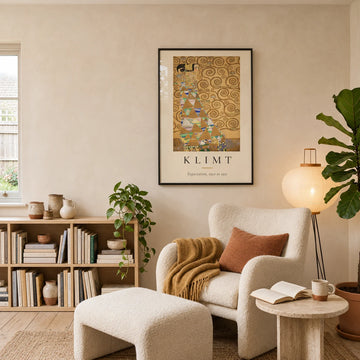

Gustav Klimt paintings fall into two very different worlds: the glittering gold portraits and lovers that made him famous in Vienna, and the quiet square landscapes he painted each summer beside a lake in the Austrian countryside. This guide covers both, starting with the rebellion that launched his career and ending with some advice on choosing a print.
Who was Gustav Klimt?
Klimt was born in 1862 at Baumgarten, near Vienna. His father was a gold engraver, and Gustav trained at the Vienna School of Arts and Crafts. As a young man he worked with his brother Ernst and their friend Franz Matsch on decorative schemes for theatres and public buildings, including the staircases of the Burgtheater in Vienna. It was steady, respected work in a traditional style, and it gave no hint of how far he would later move away from it.
What was the Vienna Secession?
In 1897 a group of young artists and architects broke away from Vienna's established artists' association, which they found conservative and closed to new ideas. They called themselves the Secession, and Klimt became their first president.
The following year they opened their own exhibition building, designed by Joseph Maria Olbrich and crowned with a dome of gilded metal laurel leaves. Above the entrance they placed their motto, which translates as "To every age its art, to art its freedom". The Secession showed work from across Europe, published its own magazine, Ver Sacrum, and treated painting, architecture and design as equal arts. Klimt's Beethoven Frieze, made for an exhibition in 1902, can still be seen in the building today. He left the group in 1905 after disagreements among its members.
These were also years of public controversy. Klimt was commissioned to paint three large ceiling pictures for the University of Vienna, and their frank, dreamlike imagery caused an outcry. He eventually withdrew from the commission. The three paintings were later destroyed by fire at the end of the Second World War.
Gustav Klimt paintings of the golden phase
Klimt's golden phase covers roughly the first decade of the twentieth century. In 1903 he travelled to Ravenna in Italy and saw its early Christian mosaics, with their flat figures set against shimmering gold grounds. That visit, along with the craft of his father's trade, fed into a style in which faces and hands are painted naturally while bodies dissolve into flat fields of pattern: spirals, eyes, circles, squares and scattered flowers.
Two paintings stand above the rest. Portrait of Adele Bloch-Bauer I, finished in 1907, shows the wife of a Viennese sugar industrialist almost swallowed by gold ornament. Seized by the Nazis, it became the subject of a long legal case, was returned to her family's heirs in 2006 and now hangs at the Neue Galerie in New York.
The other is The Kiss, painted in 1907 and 1908. It was bought by the Austrian state in 1908 and has stayed in Vienna ever since, where it hangs in the Upper Belvedere. You can bring it home as our Klimt Kiss print or, for a smaller wall, the Kiss square print.
What does The Kiss mean?
Klimt left no written explanation, so the meaning of The Kiss is open to interpretation. What we can see is a couple kneeling on a small meadow of flowers that ends abruptly at an edge. The man's robe is covered in hard black and white rectangles, while the woman's dress is full of soft circles and flowers. The two patterns meet inside one golden shape that wraps around them both.
Most people read it as a picture of love joining two different people into one. The woman's closed eyes and calm face suggest trust, though her curled toes at the very edge of the meadow hint at something more fragile. Some writers have suggested the couple are Klimt and his companion Emilie Flöge, but there is no firm evidence for this, and the painting works just as well without a name attached.
The Stoclet Frieze and the Tree of Life
Between 1905 and 1911 the architect Josef Hoffmann built a grand house in Brussels for the Belgian banker Adolphe Stoclet. Klimt designed a long frieze for the dining room, which craftsmen of the Wiener Werkstätte then made up as a mosaic. Klimt's full size working designs for it are now held by the MAK, the Museum of Applied Arts in Vienna.
The design has three main parts. At its centre is the Tree of Life, its branches curling outwards in endless spirals. On one side stands a dancing woman known as Expectation, and on the other an embracing couple known as Fulfilment, a close cousin of The Kiss. Our range includes the Stoclet Tree of Life print, the Stoclet Expectation print and the Stoclet Fulfilment print, and the three hang well together as a set.
Klimt's Attersee landscapes
From 1900 until 1916, Klimt spent most summers at the Attersee, a large lake in Upper Austria, with the family of Emilie Flöge. Away from the city he painted landscapes, and almost all of them are square. He is known to have used a viewfinder and sometimes opera glasses or a telescope to frame distant scenes, which explains why so many feel flattened, with the sky squeezed to a sliver or left out entirely.
The results are among the most peaceful pictures he made. Island in the Attersee, from around 1902, is almost all rippling water, available as our Klimt Island print. The Klimt Water Castle print shows Schloss Kammer on the lake shore, a subject he painted several times. The Klimt Attersee print is a calm view of the lake itself.
His garden and meadow pictures are just as rich. The Klimt Poppy Field print scatters red flowers across a green summer meadow, the Klimt Farm Garden print is packed edge to edge with blooms, and the Klimt Sunflower print shows a single tall sunflower standing among smaller flowers like a figure. For something moodier, the Klimt Thunderstorm print sets a dark poplar against a heavy sky.
How to choose a Klimt print
If you want warmth and drama, choose from the golden phase. The Kiss and the Stoclet designs bring rich yellows and ochres to a bedroom or living room, and they sit happily with our gold wall art and love prints. One thing to know: Klimt used real gold in several of these originals, and a print on paper shows it as warm colour rather than metal.
If you want calm, choose a landscape. The greens and blues of the Attersee pictures suit kitchens, hallways and home offices, and the square format makes it easy to build a neat row or grid. They pair well with our landscape prints and flower art prints. A mix of one golden print and two landscapes also works, because the flat, patterned way Klimt painted ties them together. To compare everything side by side, visit our Gustav Klimt prints collection.
About our Klimt prints
Each print in our range is a reproduction of a Klimt work taken from a high resolution scan that is now in the public domain. They are not originals, they are not official museum posters, and no museum is connected with them. Our team designs the layout and lettering, and every order is printed on premium matte paper with long lasting pigment inks, then posted unframed and ready for a standard frame.
Whether you are drawn to the gold or the lakeside, explore the full range of Klimt prints and choose the picture that feels right for your home.