Famous Renaissance paintings are among the most recognised images ever made, from a quiet smile in Paris to a painted ceiling in Rome. The Renaissance was a revival of interest in the art and learning of ancient Greece and Rome. It began in Italy in the fourteenth and fifteenth centuries and spread north across Europe, and its painters learned to show space, light and the human body with a new kind of realism. Here are ten pictures that sum up the period, where to see them, and what to look for when you do.
What are the most famous Renaissance paintings?
Any list is a matter of taste, but a few names appear on almost all of them: Leonardo da Vinci, Michelangelo, Raphael, Botticelli, Titian and Jan van Eyck. The ten below include their best known works, roughly in the order they were made, starting with the one picture nearly everyone can name.
1. Mona Lisa, Leonardo da Vinci
Leonardo began the portrait in Florence in about 1503 and kept working on it for years. The sitter is generally identified as Lisa Gherardini, the wife of a Florentine merchant named Francesco del Giocondo, which is why the picture is called La Gioconda in Italian. Her famous smile comes partly from sfumato, Leonardo's way of blending tones so softly that there are no hard edges around the eyes and mouth. The painting hangs in the Louvre in Paris. It was stolen in 1911 and recovered two years later, and the headlines made it more famous than ever.
2. The Last Supper, Leonardo da Vinci
Painted between about 1495 and 1498 on the wall of the dining hall of the convent of Santa Maria delle Grazie in Milan, it was made for the Duke of Milan, Ludovico Sforza. Leonardo chose the moment just after Jesus says that one of his disciples will betray him, and the twelve react in lively groups of three. He used an experimental method rather than traditional fresco, and the paint began to flake within his own lifetime. A long restoration finished in 1999, and visits are now timed and booked well ahead.
3. The Creation of Adam, Michelangelo
Michelangelo painted the Sistine Chapel ceiling in the Vatican between 1508 and 1512 for Pope Julius II, even though he thought of himself first as a sculptor. Among its many scenes, the Creation of Adam is the one everyone knows: God, carried by a crowd of figures, reaches out towards a reclining Adam, and their fingers almost touch. That small gap between the two hands has been copied and parodied countless times.
4. The School of Athens, Raphael
Raphael painted this crowded scene of ancient thinkers between about 1509 and 1511 in a room of the papal apartments now called the Stanza della Segnatura. At the centre, under a great arch, Plato points upwards to the heavens while Aristotle holds his hand out flat towards the earth, a neat summary of their two philosophies. Plato is often said to have Leonardo's features, and Raphael included his own face near the right edge, looking out at the viewer.
5. The Birth of Venus, Sandro Botticelli
Painted in Florence in about 1485, the Birth of Venus shows the goddess of love arriving on a scallop shell, blown to shore by the west wind and greeted by a figure of Spring. It hangs in the Uffizi Gallery and is closely linked to the Medici family. The pose, with one hand at her breast and the other holding her hair, comes from ancient statues of a modest Venus. Our Birth of Venus landscape print shows the whole picture above BOTTICELLI lettered on a cream page.
6. Primavera, Sandro Botticelli
A few years earlier, in about 1480, Botticelli painted Primavera, meaning spring. Venus stands in the middle of an orange grove with Cupid flying above her, blindfolded and aiming an arrow. On the left the Three Graces dance in a ring and Mercury reaches up to the clouds; on the right Zephyr, the west wind, seizes the nymph Chloris, who turns into Flora, scattering flowers. Botanists have identified a remarkable number of real plant species in the meadow. You can have it as a Primavera landscape print that keeps every figure in view.
7. The Arnolfini Portrait, Jan van Eyck
Not every great Renaissance picture is Italian. In 1434 the Flemish painter Jan van Eyck made this double portrait of a man and a woman standing in a room in Bruges. The man is usually identified as a merchant from the Arnolfini family, though exactly which one is debated. Look for the tiny details: the little dog, the oranges by the window, a single lit candle in the chandelier, and a round mirror on the back wall that reflects two more people in the doorway. Above the mirror, a Latin inscription records that Jan van Eyck was here. It hangs in the National Gallery in London.
8. Sistine Madonna, Raphael
Raphael painted this altarpiece in about 1512 for the church of San Sisto in Piacenza, and it has been in Dresden since the eighteenth century. Mary walks forward on the clouds holding the Christ Child, with Saint Sixtus and Saint Barbara on either side and green curtains drawn back like a stage. Today the most famous part is at the very bottom, where two small winged children lean on a ledge and gaze upwards. They now turn up on everything from postcards to wrapping paper.
9. Venus of Urbino, Titian
The Venetian painter Titian finished this reclining nude in 1538. A young woman lies on a white sheet looking straight at the viewer, a small dog asleep at her feet, while two maids search through a chest in the room behind. It was bought by Guidobaldo della Rovere, who later became Duke of Urbino, which gave the picture its name. Hundreds of years later it inspired Manet's Olympia. You can see it in the Uffizi, a few rooms away from Botticelli.
10. Adoration of the Magi, Sandro Botticelli
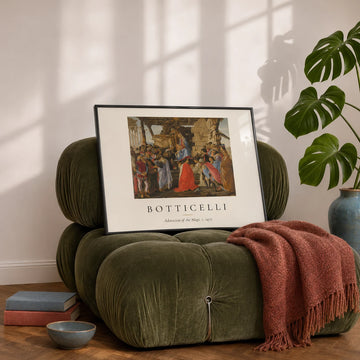
Made in about 1475 for a chapel in the church of Santa Maria Novella in Florence, this is a Bible scene and a Medici group portrait at once. Members of the ruling family appear as the three kings and their followers, and the young man in a yellow cloak at the far right, looking straight out of the picture, is widely believed to be Botticelli himself. Our Adoration of the Magi print is a landscape layout showing the full crowd around the Holy Family.
Where can you see famous Renaissance paintings?
Florence is the best single city to visit, because the Uffizi holds the Birth of Venus, Primavera, the Venus of Urbino and the Adoration of the Magi under one roof. Rome has the Sistine Chapel and the Raphael Rooms in the Vatican Museums, Milan has the Last Supper, Paris has the Mona Lisa, London has the Arnolfini Portrait, and Dresden has the Sistine Madonna. Book ahead for the Vatican, the Uffizi and the Last Supper, especially in summer.
Bringing the Renaissance home
Of all the painters on this list, Botticelli is the one we print. Alongside his best known works, our range includes the Calumny of Apelles print, a crowded allegory from about 1495 based on a description of a lost picture by an ancient Greek painter, and the Giuliano de' Medici portrait print, showing the younger brother of Lorenzo the Magnificent.
A word on what these are. Every print is a reproduction of a real Botticelli painting, taken from a high resolution scan of a work that is now in the public domain. They are not originals and they are not official museum posters. The cream page, the gold coloured rule and the lettering are our own design, and each one is printed to order on premium matte paper and posted unframed, ready for a standard frame of your choice.
Browse the full Botticelli prints collection to see every painting and layout, or start with the goddesses and Madonnas in our Botticelli prints and build a small Renaissance wall of your own.