

Few pictures are as easy to recognise as the Botticelli Birth of Venus, painted in Florence in about 1485 and now one of the best known works in the Uffizi Gallery. A pale goddess stands on a scallop shell, the wind blows her towards the shore, and a young woman waits on land holding out a flowered cloak. But who are these figures, and what did the picture mean to the people who first saw it? This guide explains the myth, the characters and the ideas behind it, and how to choose a print for your own wall.
What is the story behind the Birth of Venus?
The painting shows the arrival of Venus, the Roman goddess of love and beauty, whom the Greeks called Aphrodite. In the version of the myth told by the Greek poet Hesiod, she was born from the foam of the sea and rose from the waves fully grown. She was then carried to land, and ancient writers name the islands of Cythera and Cyprus as the places she first came ashore.
Botticelli does not paint the birth itself. He shows the moment just after it, as the goddess glides in across a calm green sea. The little waves are drawn as neat, repeated V shapes, almost like a pattern, and the coast on the right is a strip of dark trees. Nothing about the scene is meant to look like a real beach. It is a poem in paint, and every figure has a part to play.
Who is who in the painting?
Reading from left to right, there are four figures, and each one has a name.
Zephyr and his companion. On the left, two figures fly together in a tangle of wings and floating drapery. The man with puffed cheeks is Zephyr, the west wind, blowing Venus towards the shore. Wrapped around him is a woman who is usually identified as the nymph Chloris, whom Zephyr loved, although some historians think she is Aura, the spirit of a gentle breeze. Pink roses tumble through the air around them, and an old tradition says the rose first appeared at the same moment as the goddess.
Venus. In the centre, the goddess stands on the edge of a huge shell, her long golden hair lifting in the wind. She is the one still point in a picture full of movement, and she looks out past us with a calm, slightly distant expression.
The Hora of Spring. On the right, a young woman steps forward to wrap Venus in a cloak patterned with flowers. She is one of the Horae, the goddesses of the seasons, and most writers identify her as the Hora of Spring. Her white dress is sprinkled with small flowers too, so the arrival of love and the arrival of spring are tied together.
Why does Venus stand that way?
Look at her hands. One covers her breast and the other gathers her long hair in front of her body. This is a pose borrowed from ancient sculpture, known as the Venus Pudica, which means the modest Venus. Statues of the goddess in this position were made in ancient Greece and copied by the Romans, and Botticelli would have known the type from classical works being collected and studied in Florence at the time.
The figure is not anatomically realistic. Her neck is unusually long, her shoulders slope steeply, and her weight rests on one leg in a way that would be hard to hold for long. Botticelli cared more about a flowing outline than about strict accuracy, and that graceful, slightly unreal quality is a large part of why the picture feels so memorable.
A popular story says the model was Simonetta Vespucci, a young woman admired in Florence who died in 1476. It makes a romantic tale, but there is no firm evidence for it, and most historians treat it as legend.
Who commissioned the Botticelli Birth of Venus?
No contract or payment record survives, so nobody knows for certain. The painting is closely tied to the Medici, the banking family who dominated Florence in the fifteenth century. In the sixteenth century the writer Giorgio Vasari saw it, together with the Primavera, at the Medici villa at Castello outside the city. It is often linked with Lorenzo di Pierfrancesco de' Medici, a younger cousin of Lorenzo the Magnificent, though historians still debate who first owned it.
Botticelli worked for the family for many years and painted several of its members. Our Giuliano de' Medici print is an upright portrait of Lorenzo the Magnificent's younger brother, who was murdered in Florence Cathedral during the Pazzi conspiracy of 1478.
What does the Birth of Venus mean?
At its simplest, the picture tells a well loved myth for a wealthy private house. But Florence in the 1480s was also home to a circle of scholars, led by the philosopher Marsilio Ficino, who were reading Plato and trying to bring his ideas together with Christian belief. Their thinking is usually called Neoplatonism.
In this way of thinking, Venus could stand for two kinds of love: an earthly love of the body and a heavenly love of pure beauty, which could lift the mind towards God. Many historians read the painting as the heavenly Venus, beauty itself arriving in the world, calm and untouched. The poet Angelo Poliziano, who belonged to the same Medici circle, also wrote verses describing Venus carried to shore on a shell, and they may have helped shape the scene. None of this is written on the painting, so these readings remain interpretations rather than facts.
The goddess appears in several other Botticelli pictures. In the Primavera landscape print, from about 1480, she stands in an orange grove at the centre of a spring garden. In Venus and Mars, a wide picture from about 1485, she watches over the sleeping god of war while little satyrs play with his armour. And the Venus and the Three Graces print comes from a wall painting made for a villa near Florence, showing the goddess and her companions offering gifts to a young woman.
Choosing a Botticelli Birth of Venus print
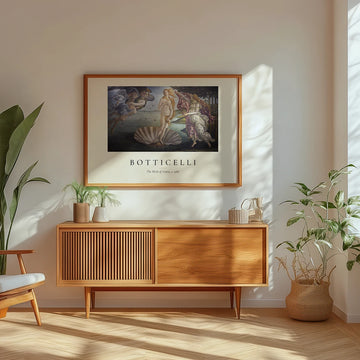
The original is nearly three metres wide, so the first thing to think about is shape. Our Birth of Venus print is a landscape layout. The whole painting sits at the top of a warm cream page, with BOTTICELLI in spaced capitals beneath it, a thin gold coloured rule, and the title and date in a classic italic. Nothing is cropped, so Zephyr, the shell and the Hora of Spring all stay in view.
A wide print like this works best on a wide wall: above a sofa, over a bed, or along a sideboard or console table. Give it room to breathe and hang it so the middle of the picture sits at roughly eye level. Its soft blues, greens and pinks also suit a bathroom, where the sea and the shell feel at home.
If your wall is narrow, consider the Botticelli Venus print instead. It shows the goddess alone in the same modest pose, without the sea or the wind gods, on an upright page that fits a hallway, an alcove or the space beside a window. For a pair, put the Birth of Venus print above a bed and the Primavera on a facing wall, or hang the single Venus next to a portrait from the same studio.
About our prints
We want to be clear about what you are buying. Our prints are reproductions made from high resolution scans of the original paintings, which are now in the public domain. They are not originals, and they are not official museum posters or licensed by the Uffizi. We design the cream page and the lettering ourselves, and each print is made to order on premium matte paper and sent unframed, sized to fit standard frames.
To see every painting and layout we offer, browse the full Botticelli prints collection, where you will find his goddesses, Madonnas and Florentine portraits side by side. If the Botticelli Birth of Venus has always been your favourite, start there and see which of his other pictures sits well beside it in our Botticelli prints.