
The lotus flower meaning most people know is purity and rebirth: the plant is rooted in the mud at the bottom of a pond, yet its flower opens clean and bright above the water. That simple picture has made the lotus one of the oldest symbols in Asian art, with extra layers of meaning in Buddhism, Hinduism and Chinese and Japanese art, while the ancient Egyptian "lotus" was really a water lily with a sun story of its own. Here is what it means, and how to bring a lotus print into your home.
Why Does the Lotus Symbolise Purity and Rebirth?
The sacred lotus (Nelumbo nucifera) grows in still, shallow water with its roots in silt. Its round leaves and its flowers rise on long stalks well above the surface, and the leaves are famously water repellent: rain beads up and rolls off, carrying dirt away with it. Scientists even call this self-cleaning trick the "lotus effect". Many traditions read this as a picture of staying good and clear in a messy world.
The idea of rebirth comes from its rhythm. Each bloom opens in the morning and partly closes again later in the day over its few days of flowering, and in cooler climates the whole plant dies back in winter before rising again from its roots in spring. Lotus seeds are remarkably long lived too: in scientific studies, seeds several centuries old have been coaxed into growing. A flower that keeps coming back fits naturally with renewal and a fresh start.

What Is the Lotus Flower Meaning in Buddhism?
In Buddhism the lotus is a central image for a mind that rises out of confusion into clarity. Early Buddhist texts compare an awakened person to a lotus that grows up through the water but stands above it, untouched and unstained, and later art carried that comparison everywhere. The Buddha and many bodhisattvas are traditionally shown seated or standing on an open lotus, usually called a lotus seat or lotus throne.
The lotus is also one of the Eight Auspicious Symbols found in Tibetan and other Buddhist art, and it gives its name to the Lotus Sutra, one of the most influential Mahayana texts. The cross-legged meditation posture is called padmasana, the lotus position, and the well known mantra om mani padme hum contains padma, the Sanskrit word for lotus. The blue utpala, another water flower, is often shown with Manjushri, the bodhisattva of wisdom. Our post on Buddha artwork looks at more of these images, and our Buddha wall art brings them onto your walls.
What Does the Lotus Mean in Hinduism?
In Hindu tradition the lotus, or padma, is linked with beauty, fertility, good fortune and the divine. Lakshmi, the goddess of wealth and prosperity, is very often shown seated or standing on a pink lotus with lotus flowers in her hands, and one of her many names is Padma. In a widely told creation story, the god Brahma appears on a lotus that grows from the navel of Vishnu. Saraswati, goddess of learning and music, is often painted seated on a white lotus.
The flower runs through yoga and tantric thought too. There the chakras, the body's centres of energy, are pictured as lotuses with different numbers of petals, and the crown chakra is described as a thousand petalled lotus. The lotus is also the national flower of India.

Did Ancient Egypt Have the Lotus?
Yes and no. The flower usually called the Egyptian lotus, painted on tomb walls and carved on columns, is in fact a water lily: the blue water lily (Nymphaea caerulea) and the white Egyptian water lily (Nymphaea lotus). The sacred lotus of Asia is generally thought to have reached Egypt much later, around the Persian period.
The meaning is close all the same. The blue water lily opens in the morning and closes by afternoon, so Egyptians linked it with the sun, which sets each evening and rises again. In some Egyptian creation accounts the sun first emerges from a lotus floating on the waters at the start of the world. That made the flower a sign of creation and rebirth, which is one reason it appears so often in funerary art.
What Do the Different Lotus Colours Mean?
You will find long lists of lotus colour meanings online. These are modern popular associations, drawn loosely from Buddhist and Hindu art, not fixed ancient rules, and sources disagree. The ones you see most often are:
- White: purity and a calm, clear mind.
- Pink: often described as the most sacred colour, and linked in popular accounts with the Buddha himself.
- Red: love, compassion and the heart.
- Blue: wisdom and learning, echoing the blue utpala.
- Purple and yellow: sometimes given spiritual or mystical meanings.
One botanical footnote: the true lotus only comes in shades of pink and white, plus the pale yellow American lotus (Nelumbo lutea). Blue and purple "lotus" flowers are water lilies, so those colours belong more to art and to the Egyptian story than to the plant itself.
What Does the Lotus Mean in Chinese and Japanese Art?
In China the lotus became a symbol of integrity. The Song dynasty scholar Zhou Dunyi wrote a much loved short essay praising the flower for rising from the mud without being stained, and the upright lotus came to stand for an honest, decent person. The Chinese word for lotus, lian, also sounds like the words for "continuous" and "integrity", which makes it a favourite in picture puns. A lotus painted with a fish is a popular New Year wish for plenty year after year, because yu, fish, sounds like the word for surplus.
In Japan the lotus, hasu, arrived with Buddhism and is still closely tied to it. In Pure Land Buddhism, widely followed in Japan, the paradise of Amida Buddha is filled with lotus ponds, and believers are said to be reborn there on lotus flowers. Lotus ponds became a favourite subject for Japanese brush painting and woodblock prints, and a traditional lotus painting tends to keep things spare: a few leaves, a bud or two, still water and plenty of empty space. You can find more of these ideas in our guide to Japanese symbolism and in our Japanese wall art.

Lotus Flower Art for Your Home
A lotus print brings that story of calm and renewal into a room without saying a word, in a bedroom, bathroom, reading corner or anywhere you want to slow down. All of these prints start from £16, and you will find them, in our lotus wall art collection, with more calm designs in Zen wall art.
1. Lotus Flower Print
The Lotus Flower Print shows soft pink lotus flowers above broad green leaves and pale blue water, with slim reeds and a column of Japanese script in the top corner. Lovely on a green or cream wall.
2. Lotus Reflection
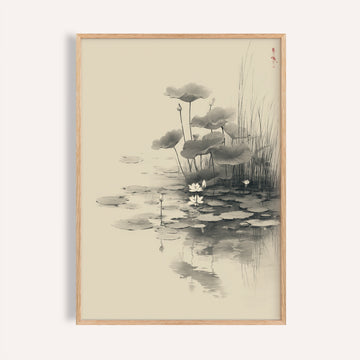
For a lotus flower painting in the ink tradition, Lotus Reflection sets tall grey leaves, reeds and a few small white blooms against a warm beige ground, mirrored in still water. Lots of empty space makes it ideal for a bedroom.
3. Zen Blossom
Zen Blossom is a single open bloom in greys and black on a dark ground, with a small burst of orange at its heart and one large leaf below.
4. Chakra Crown
Chakra Crown is a symmetrical, stylised lotus in black and grey on cream with one small orange petal. The name nods to the thousand petalled crown lotus, and it looks right at home in a yoga or meditation space.
5. Lotus Embrace
Lotus Embrace shows two pale hands cupping a dark lotus with a bright orange centre, set against black and grey blocks.
6. Harmony of Nature
Harmony of Nature pairs a tall black lotus, with a round orange centre like a rising sun, with a patterned fish and a smaller bloom on a cream ground. A cheerful modern lotus and fish pairing.
7. Lotus Serenade
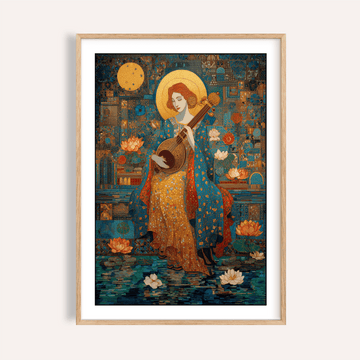
Lotus Serenade is a haloed musician playing a veena, the instrument most often shown with Saraswati, surrounded by teal and gold mosaic patterns, with lotus flowers floating at her feet.
8. Lotus Whispers
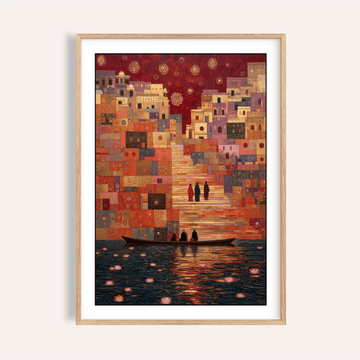
Lotus Whispers is inspired by the riverside steps of Varanasi: stacked buildings in reds, pinks and golds, a small boat, and pink lotus flowers scattered across dark water. Find more like it in our Indian wall art.

How Do You Style a Lotus Print?
- Match the mood of the room. Soft ink and pale pink lotus art feels restful in bedrooms and bathrooms, while bold black and orange designs suit a modern living room or hallway.
- Echo the colours. Linen, pale wood and green plants pick up the quieter prints, and warm terracotta or rust walls bring out the richer ones.
- Mix it with other plants. A lotus sits happily in a wall of botanical prints or alongside our flower art prints.
- Good to know. Our regular prints are printed on premium matte paper. Each one is made to order and usually dispatched within 1 to 2 days, UK orders typically arrive in 3 to 6 days, and UK delivery is free over £50.
Lotus Flower FAQs
Is a lotus the same as a water lily?
No, although they look alike and are often confused. Lotus leaves and flowers stand up above the water on stalks, and the leaves are round with no split. Water lily pads float flat on the surface and have a notch cut into them. After flowering, a lotus leaves a seed head that looks like a watering can rose.
Is the lotus flower edible?
Yes. Lotus root and lotus seeds are eaten across much of Asia, and the large leaves are used to wrap food for steaming.
Where do lotus flowers grow?
The sacred lotus is native to warm parts of Asia and to northern Australia, and the yellow American lotus grows wild in North America. In the UK it needs plenty of summer warmth, so you will mostly see it in botanic garden glasshouses or in pots in sunny, sheltered spots.
Is it lucky to have a lotus print at home?
In many Asian traditions the lotus is seen as an auspicious flower, tied to purity, prosperity and new beginnings. Most people simply choose it because it feels calm.
Whether you are drawn to its Buddhist roots, its Hindu goddesses or the simple sight of a clean flower rising from a muddy pond, the lotus flower meaning has stayed remarkably steady for well over two thousand years: something good can grow from difficult ground. Browse our lotus wall art to find a lotus print for your own quiet corner.