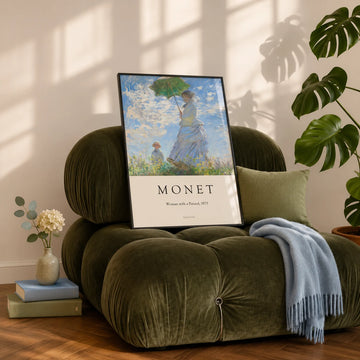
Monet water lilies are some of the most loved paintings in the world, and every one of them began at a single garden pond in Normandy. For almost thirty years Claude Monet painted the same stretch of water at Giverny again and again, in every season and at every hour of the day. This guide looks at how the pond was made, how the series grew, why the late pictures look so different from the early ones, and how to choose a print for your own home.
Where did Monet paint the water lilies?
Monet moved to Giverny, a small village beside the Seine in Normandy, in 1883. He rented the house at first and bought it in 1890, once his paintings had started to sell well. In front of the house he planted a large flower garden, but the pond came later.
In 1893 he bought a piece of low, marshy ground across the road from his garden. With permission from the local authorities, he diverted water from a small stream nearby to fill a pond, and over the following years he enlarged it. He planted water lilies in white, pink and yellow, and ringed the banks with weeping willows, bamboo, irises and other plants chosen for their shapes and colours. A gardener looked after the pond, keeping the water clear and the lily pads clean, so that it was always ready to be painted.
It is worth remembering that Monet made this place himself. The water garden was not a view he came across by chance. He designed it, planted it and tended it, and then spent the rest of his life painting it.
Why did Monet build a Japanese bridge?
Like many artists of his time, Monet admired Japanese woodblock prints, and he collected them for decades. They still hang on the walls of his house at Giverny today. Curved wooden bridges over water appear in many of those prints, and Monet built one of his own across the narrow end of his pond, painted green rather than the red often seen in Japan.
In 1899 he set up his easel on the bank and painted a group of views of the bridge, all from nearly the same spot. The Japanese Footbridge belongs to this group. The bridge arches across the top of the picture, the water below is crowded with lily pads and small pink and white flowers, and thick green leaves close in on every side. Later he trained wisteria over the bridge, and when he returned to it in his last years the scene became a blaze of loose, fiery strokes.
This is the painting at the heart of our range. The Monet Footbridge poster shows the whole picture in a museum style layout with the artist's name in lettering below.
How many Water Lilies did Monet paint?
Monet painted around 250 pictures of his water lilies, from the late 1890s until his death in December 1926. The French name for the series is Nymphéas, and it covers everything from small, careful studies to huge panels several metres wide.
The series changes a great deal over those years. The early pictures still show the bank, the bridge and a sense of where the viewer is standing. Gradually the edges of the pond disappear. In many of the later paintings there is no shore and no horizon at all, only the surface of the water, the floating pads and the reflections of the sky, clouds and willows. You are looking down into the pond rather than across it, and the reflections can be as important as the flowers themselves.
Today the paintings are spread across museums in Europe, America and Japan, which is one reason so few people have seen more than a handful of them in person.
Did Monet's eyesight change his paintings?
Yes, and it is one of the most moving parts of the story. In 1912 Monet was told he had cataracts in both eyes. Over the next decade his sight grew steadily worse. Colours seemed dull and muddy to him, blues and greens faded, and the world took on a yellowish cast.
His paintings from these years are full of reds, oranges and browns, with brushwork that is broad and urgent. These were also years of loss. His second wife, Alice, died in 1911, and his eldest son, Jean, died in 1914. For a time Monet painted very little. In 1923 he finally agreed to an operation on one eye, and afterwards his sense of colour partly returned, though it never fully settled. He kept painting the pond almost until the end of his life.
Where are the big Water Lilies paintings?
Alongside the easel paintings, Monet spent his final years on an enormous project: a set of panels showing the pond on a vast scale, meant to surround the viewer. He built a large new studio at Giverny so he had room to work on them.
On 12 November 1918, the day after the armistice that ended the First World War, Monet offered the panels to France as a gift and a monument to peace. His close friend Georges Clemenceau, the prime minister, helped make it happen. The panels were installed in two oval rooms at the Musée de l'Orangerie, in the Tuileries garden in Paris, and opened to the public in 1927, a few months after Monet died. Eight huge compositions curve around the walls, lit by daylight from above, and walking through them feels like standing in the middle of the pond. If you are ever in Paris, it is one of the quietest and most rewarding rooms in the city.
How to choose a print of Monet water lilies
Start with the shape of your wall. The Footbridge landscape print shows the full width of the bridge and the pond beneath it, which suits the space above a sofa, a bed or a sideboard. For a smaller wall, a narrow hallway or a grid of pictures, the Footbridge square print is the easier fit. The poster layout sits well on its own in a study or a bedroom.
Next, think about colour. The greens, soft pinks and creams of the footbridge painting are calm and restful, and they suit bedrooms, bathrooms and any room you want to feel quieter. If you would like a companion piece, look at The Seine at Giverny, painted in 1897 on the river near his home. Trees and their reflections dissolve into morning mist, with almost no line between bank and water. It comes as a Giverny Seine poster or a Giverny Seine landscape print, and it sits naturally beside the footbridge because both come from the same few miles of Normandy.
For a warmer contrast, the Monet Vétheuil garden print shows tall sunflowers on a sunny path at an earlier home. You can see all the paintings and layouts together in our Claude Monet prints collection, and the water garden pictures also pair well with our botanical prints and landscape prints.
About our Monet prints
Our prints are reproductions of Monet's paintings, made from high resolution scans of works that are now in the public domain. They are not original works and not official museum posters, and no museum is involved with our range. We design the layouts, borders and lettering ourselves, and every print is made to order on premium matte paper with fade resistant inks, then sent unframed so it fits a standard frame of your choice.
If the story of the pond has caught your imagination, browse the full range of Monet prints and find the view of Giverny that suits your room.